 |
 |
Review by Brian Keene |
||
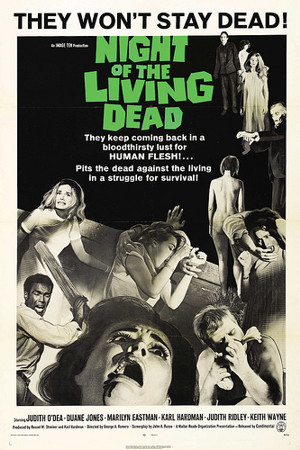
NIGHT OF THE LIVING DEAD- 1968USA Release: Oct 4, 1968 Image Ten Production, Continental, Elite Ratings: Australia: M / Finland: K-18 / France: -16 / Switzerland: 16 / UK: 18 / USA: UNRATED |
||||
In 1968, America found itself mired in the grip of social, political and racial upheaval. The Vietnam War was exploding and the body count was broadcast every night into the dubious comfort of our households. Generations were clashing, seeing each other as the enemy. Battle lines were being drawn over the color of a person's skin and the length of their hair. During this time, "B" movies reigned supreme, churned out of Hollywood faster than Japan can churn out Pokemon' cards.
One of those "B" movies, a small black and white venture from John Russo (RETURN OF THE LIVING DEAD) and George A. Romero (DAWN OF THE DEAD, DAY OF THE DEAD) would go on to become one of the most influential and important horror films of all time. It would become legendary as a film that not only started an entire sub-genre, but also accurately and without apology, mirrored all the strife that those times had to offer.
That film was NIGHT OF THE LIVING DEAD.
The movie's plot is simple enough. A young woman named Barbara (Judith O'Dea) and her brother, visit their father's grave at a cemetery in the rural backwoods of Pennsylvania. The first hint of the socio-political commentary this film has to offer takes place in the first few minutes, as Barbara's brother mocks her dutiful prayer, derisively scoffing at the very notion of church or God. For 1968, this was risqué stuff.
TRIVIA |
Yet this is what Ben described (25 minute mark). |
Ben: "You know a place back down the road called Beekman's? Now I didn't see them at first. I could just see that the truck was moving in a funny way. Those things were catching up to it! The truck went right across the road. I slammed on the brakes to keep from hitting it myself. It went right through the guardrail. I guess. I guess the driver must have cut off the road into that gas station by Beekman's Diner. It went right through the billboard. Ripped over a gas pump and never stopped moving." |
What's more, Director Zack Snyder shot the scene exactly as Ben described it (and writer James Gunn adapted it) in DAWN OF THE DEAD (2004) |
Official Websites of Conversing with a Zombie is difficult in the best of times, and since a Zombie Apocalypse can never be considered The Best of Times, learn your lingo with Internet's good old, |
Within minutes, they are attacked by a zombie, which kills her brother. Soon, Barbara is pursued by several zombies, eager to consume her warm flesh. She takes shelter in an old farmhouse.
Soon, our heroine has company. The film's hero, Ben (Duane Jones) arrives on the scene, also seeking refuge in the farmhouse. Ben was unlike anything ever seen in Hollywood at that point. He was black. Standard convention advised against having a black man as your main hero. To compound things, he wasn't a "suburban black man". Nope. This brother was from the streets, and he let viewers know it.
In the first twenty minutes of their scene together, Barbara is more scared of Ben than she is of the ghoulish army encamped outside the house. Again, Romero perfectly reflected the racial turmoil of the time.
Soon, they are joined by five other refugees from the nightmare, including Harry Cooper (Karl Hardman) who typifies the average white, middle aged xenophobic businessman of the era, his daughter Karen (Kyra Schon) and his wife Helen (Marilyn Eastman), who is beginning for the first time in her life, to question her husband's judgement and motives. Again, the movie speaks of deeper issues, touching on women's liberation and "good old boy" and "old money" values.
After barricading themselves in the house, cabin fever soon begins to pick at the group, inflicting more damage than even the zombies can do, culminating in a desperate struggle against not only the cannibalistic hordes outside, but against each other as well.
Perhaps the most memorable moment in NIGHT OF THE LIVING DEAD, is the ending. Romero provides a conclusion so shocking and so unexpected, that critics of the era were unsure what to make of it. Audience reaction at the time was one of strong disbelief.
Another interesting aspect of Romero's "Zombie Mythos", is that no firm explanation for the dead arising and eating the living is ever given. In this film, it is speculated that a recent space probe returned from Venus may have caused the change, due to background radiation (at the time, America was in the grip of nuclear war fever and the dangers of radiation were on everyone's mind).
In the sequel, DAWN OF THE DEAD, the cause is hinted at being viral in nature (at a time when America was starting to wake up to the perils of infectious disease). By the third movie, DAY OF THE DEAD, we don't know what the hell is causing it, and the inept remnant of the government are too busy squabbling amongst themselves to figure it out (Iran-Contra, Watergate, etc.).
NIGHT OF THE LIVING DEAD truly deserves the praise and acclaim that has been showered upon it over the past few decades. If ever a horror movie were a masterpiece, this one is it. An important milestone in cinematic history and proof of what independent filmmakers can do, NIGHT OF THE LIVING DEAD is the seminal zombie movie.
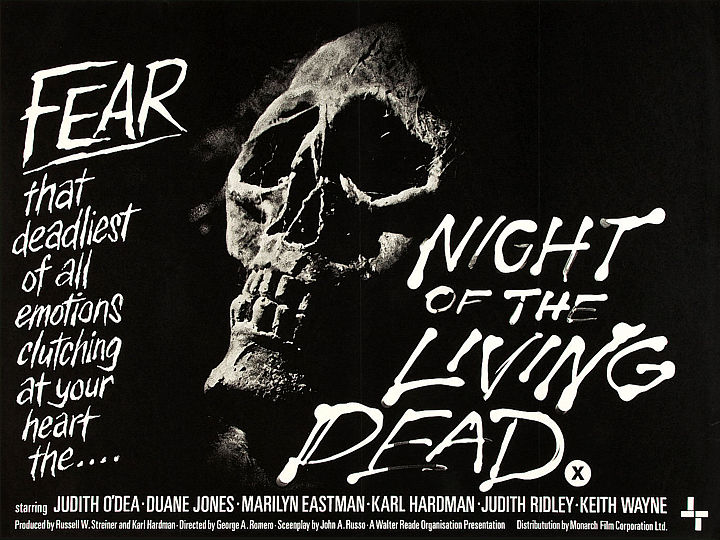
I give it five shriek girls.

This review copyright 2000 E.C.McMullen Jr.

|
| GET COVERED | |
| YOU MIGHT ALSO ENJOY (Sub-Section: ZOMBIES!!!) |
||
 |
 |
 |
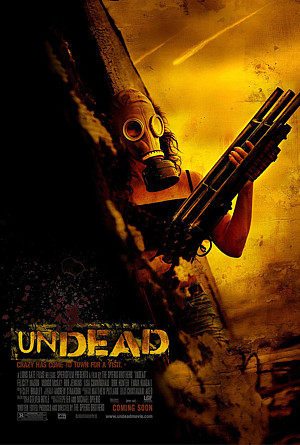
| UNDEAD MOVIE REVIEW |
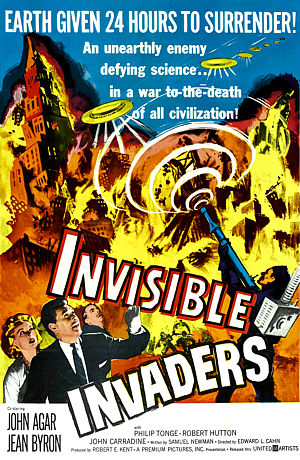
INVISIBLE INVADERS MOVIE REVIEW |
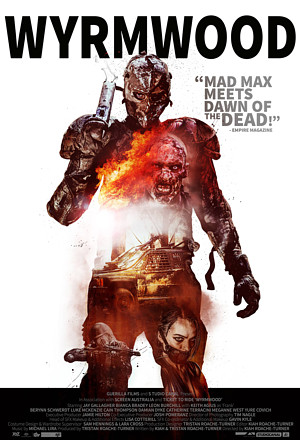
WYRMWOOD MOVIE REVIEW |
FEO AMANTE'S HORROR THRILLERCreated by:E.C.McMullen Jr. FOLLOW ME @ |
| Amazon |
| ECMJr |
| Feo Blog |
| IMDb |
| Stage32 |
| X |
| YouTube |
| Zazzle Shop |