 |
 |
Article by |
The PSYCHO Sequels
By James Futch

Pre production
| PSYCHO MOVIE REVIEW |
| PSYCHO II MOVIE REVIEW |
| PSYCHO III MOVIE REVIEW |
Producer Hilton Green knew from the onset that the look of the film was crucial. The old, Gothic Victorian house with its interior horrors and the motel with the flashing neon sign were already familiar icons in 1982. Thus, it was essential to duplicate, as exactly as possible, the sets and locations of the original PSYCHO.
"The movie's homecoming scenes strike a nerve," said Roger Ebert in his review of the film, "After all, that is the Bates Motel, and few images of Sir Alfred's long career have remained more indelibly etched in the memories of moviegoers."
"The house is as important as Norman," explained Richard Franklin, "It is a time capsule. It represents all the values of his past, his mother and society. It's 22 years later, but Norman and the house haven't changed very much. They are both time capsules."
The "PSYCHO house" was undoubtedly based on a painting called House by the Railroad (Museum of Modern Art, New York) by American artist Edward Hopper. The 1925 oil on canvas is of a gray, three-story California Gothic manse against a treeless background. In the foreground is the worm's eye perspective of railroad tracks. The house is so astonishingly similar to the PSYCHO house that the casual viewer might confuse the two.
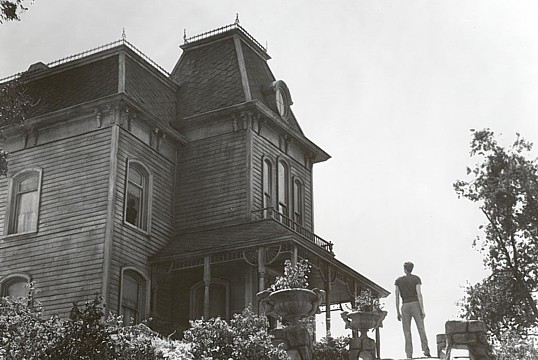
Also, the accustomed perspective of the PSYCHO house is virtually the same as its inspiration. The window in which "Mother" is seen sitting in the film is there in the Hopper painting. And even the remote setting is not without similarity. As the house in PSYCHO is cut off from the rest of the world when the new highway replaces the old, so too, might Hopper's house be equally isolated by those railroad tracks. Both houses are doomed by arteries of transportation and progress.
|
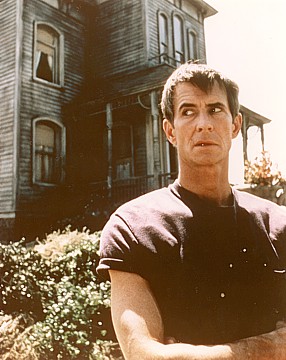
The dusty old house was still on the Universal back lot, but had been moved from the site where Hitchcock filmed PSYCHO. Trivia buffs will be interested to learn that the PSYCHO house was in other non-PSYCHO related films and TV shows throughout the 1970's and early 80's before the sequels reclaimed it. In fact, a scant year before PSYCHO II, the exterior of the house was painted pink and appeared in the Chevy Chase comedy MODERN PROBLEMS (1981). Through the magic of movies, the house somehow was transported to the beach but cleverly enough the ocean and the house are never in the same shot.
The crew moved the house to a more suitable site for filming and landscaped it to look as much like the original as possible. Unfortunately, the motel had long since been torn down, and production designer John Corso used photographs and old blueprints from the original film to reconstruct the motel from the ground up. Special effects man Albert Whitlock created the hill and trees behind the motel, the sky and clouds, the neon sign, through matte painting. Matte paintings are an old technique used to create backgrounds and locations by painting them on glass and then shooting the film through it. The painted areas on the glass replace the backgrounds in the shot.
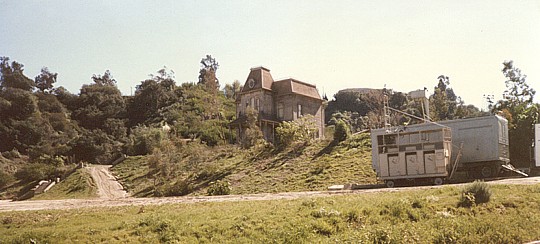
A different view of the infamous PSYCHO house on the Universal back lot.
No color photos exist of the making of the original PSYCHO. The filmmakers of PSYCHO II consulted Richard Anobile's book of frame blow-ups from the original PSYCHO (with over 1300 frame blow-up photos shown sequentially and coupled with the complete dialogue from the original soundtrack). The book became an indispensable tool throughout the early production stages of the film. Using the stills from the book and consulting with Hilton Green who worked on the original, set decorator Jennifer Polito hunted down many of the actual props from the first film, which amazingly, had been collecting dust in a prop rental house in Los Angeles.
|
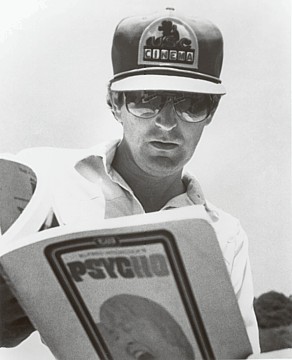
Among the original props recovered were many of the stuffed birds, including the owl and raven, the Tiffany lamps in the motel parlor, the armoire, bed, fireplace and the folded "praying" hands on "mother's" dressing table in "mother's" room, and the stained glass window in the hallway leading to the kitchen.
Screenplay
Tom Holland (CHILD'S PLAY) wrote the screenplay to PSYCHO II. His previous credits included two excellent thrillers, THE BEAST WITHIN and CLASS OF 1984. The team of Bernard Schwartz, Hilton Green, and Richard Franklin made their decision to hire Holland on the basis of his script for the psychological thriller SCREAM FOR HELP.
"[PSYCHO II] is a story about people who don't want to be what they are but can't escape their fate or their past," said Tom Holland in 1986, "Norman Bates carries an essential goodness with him… He wants to make it; he wants to keep his sanity and his grasp on reality."
Anthony Perkins expressed surprise upon reading the screenplay.
"For years I'd resisted the whole idea of PSYCHO exposure. I felt PSYCHO had been sufficient in itself. It was a well-constructed story. It never occurred to me there would be more juice in those characters. When I received Tom Holland's script I liked it very much. It is a well-crafted narrative which is a logical extension of the first story."
Cinematography
Cinematographer Dean Cundey (HALLOWEEN, HALLOWEEN II, THE THING) tried to match the look and mood of Hitchcock's original by implementing the German Expressionist style of filmmaking, that is, deep pockets of chiaroscuro and distorted sets, which had also influenced Hitchcock.
"This meant creating the sensation for the audience that they are seeing a continuation of the first film," said Cundey. The director and cinematographer wanted the audience to draw the parallel between the style and compositions in the sequel and those used in the first PSYCHO.
Although the new film was in color, Cundey utilized Kodak's new 5293 High Speed Negative film, which accounts for the film's high contrast look, and distinctive treatment of shadows and light.
More new techniques were utilized, such as the Louma crane, an invention that was still new when PSYCHO II was being made. The Louma crane was a mounted camera on the end of a long pole, giving the operator more flexibility in bird's eye view shots. Dean Cundey explained:
"[The Louma crane] is manipulated by the operator who watches the camera though a TV system. As such, you are only limited by where you can poke the end of the pole that has the camera on it."
Cundey used the Louma crane to accomplish sweeping moving shots of the house, from the ground to the gingerbread roof 40 feet in the air.
PAGE 4: Remaining True to the Original 
PSYCHO, PSYCHO II, and PSYCHO III photos copyright 1983 and 1985 Universal Studios, Inc.
All rights reserved. May be reprinted for newspapers and other periodicals.
This article copyright 2002 E.C.McMullen Jr.

|
| CHANGE YOUR SHIRT | |


| YOU MIGHT ALSO ENJOY (Sub-Section: PSYCHO and Mother's Children) |
||
 |
 |
 |
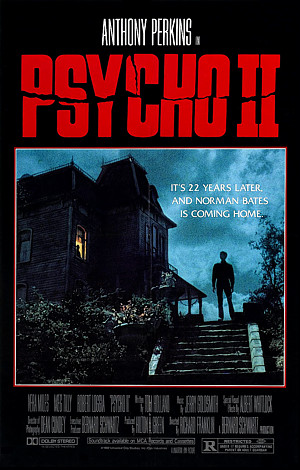
| PSYCHO II MOVIE REVIEW |
BARON BLOOD MOVIE REVIEW |
FRIDAY THE 13th MOVIE REVIEW |
FEO AMANTE'S HORROR THRILLERCreated by:E.C.McMullen Jr. FOLLOW ME @ |
| Amazon |
| ECMJr |
| Feo Blog |
| IMDb |
| Stage32 |
| YouTube |
| Zazzle Shop |