|
SPOILERS AHEAD
!!!SCIENCE MOMENT!!!
BEWARE THE SCIENCE OF THESE TITLES FROM THE
2000s |
2003
DAREDEVIL - 2003
I have no problem with almost everything here. Who knows, maybe some
odd side effect to toxic waste could produce a good mutation instead
of the much more likely bad ones.
The only genuine mistake involves the Daredevil's ability to dodge bullets because he hears them coming.
I'm sorry, but no. Bullets travel faster than the speed of sound.
They would arrive at your skull before the sound got to your ear. |
|
X-MEN 2 - 2003
I want to say something about physics and biology (which,
like all sciences, is a mere subset of physics). Biology
first. Narration and conversation at several points make references
to mutants being the next "stage" in evolution and they
compare their situation with the “conflict” between Neanderthals
and Cro-Magnons. Both points of view are inaccuracies based on the
common misconception that evolution is some mysterious force driving
life toward greater intelligence and that we (and now mutants) are the pinnacles of that achievement. In fact,
evolution could care less how smart you are. All evolution cares
about is how good you are at reproducing. If being dumber helped,
then each generation dumber people would produce more offspring
until the human species was gradually replaced by a less intelligent
breed (Hey, wait a minute…).
Thus, being able to freeze things like Iceman does is great fun but if it doesn’t
help you get a date or support your offspring to make sure they
survive long enough to breed, then evolution doesn’t apply.
And the Neanderthal / Cro-Magnon situation is spurious as well. When modern humans entered
Europe 30,000 years ago the Neanderthal had been living there already
for at least 100,000 years. Within 5,000 years of our arrival the
Neanderthal were gone. This wasn't a war or anything –
we simply out bred them. We were better able to compete for resources
(because we were smarter, but that part's still disputed) and generation by generation they declined
and we increased. The situation in the movie doesn't fit the
details very well.
And now the physics. The fact is the powers possessed by these mutants clearly
violates one of the most hallowed rules of science: The Conservation
of Mass and Energy (neither mass nor energy
can be created or destroyed – merely change form). In
other words, where does the energy come from for Jean Grey’s
telekinesis or Storm’s movement of huge masses of air? Are
these things impossible?
No. But you have to assume that the basis for all mutant power is the ability
to tap into some unknown energy source. What it is and what dimension
it exists in is a mystery but if you assume its existence you can
explain everything else. |
|
DREAMCATCHER - 2003
If you had advanced space travel and the kind of quick spreading fungus
/ bio-weapon shown here, it would be a simple matter to seed the upper
atmosphere with it and rain it down all over the Earth (a-la INVASION OF THE BODY SNATCHERS - Feo). The conquest these
aliens seem bent on would happen quickly and without firing a shot. Proof,
perhaps, that just because someone comes from a culture with more advanced
technology doesn't mean they’re automatically very smart. |
|
THE MATRIX RELOADED - 2003
I was pleased to see no attempt to add to the ridiculous idea mentioned
in the first film that the machines are using their unwitting human
slaves as a power source. That's just plain stupid for a long
list of reasons and they wisely skipped over it here.
On the other hand a lot of the computer references are as ancient as Tron. The
story centers around a plan to get into the enemy “mainframe”,
an idea right out of the 70’s.
Have these artificial intelligence
programs not heard of distributed networks? Like, for example, the
Internet?
The Internet has no “central” computer, nor
does it need one. I find it hard to believe that these vastly more
advanced computers would take such a giant step backwards. |
|
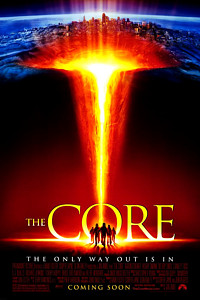 THE CORE - 2003
Now, I'm not going to discuss the magical underground drillship.
A half-crazy lone scientist inventing something essentially impossible is a staple of science
fiction so that's fine. But I do have a problem when the movie
makes scientific sounding statements that are just plain wrong.
Here are the high points:
1. If there
really were "solar microwaves" being held off by the Earth's
magnetic field, why didn't they cook the Apollo astronauts
when they ventured beyond the field's coverage? Why isn't
Mars being cooked, since it hasn't got much of a field? The
answer is that the sun doesn't produce much in the way of microwaves
and that what it does produce isn't stopped by our magnetic
field anyway. A magnetic field can only affect the paths of charged
particles like protons and electrons. It has no effect at all on
electromagnetic radiation like microwaves or visible light or ultraviolet
light. It's our atmosphere – not our magnetic field –
that filters out the harmful parts of the sun's radiative output.
2. The inner
core of the Earth is a ball of crystalline iron about 2400 kilometers
in diameter. A good way to get a feel for how much energy would
actually be required to get it spinning again if it stopped can
be found from calculating the rotational energy it has right now.
This is the rotational equivalent of kinetic energy: the energy
of motion. Plugging in the numbers reveals that the inner core has
a rotational energy of 385 trillion trillion joules. That's
equivalent to 96 billion megatons of TNT, so the mere 1000 megatons
worth of nukes they bring along is about 100 million times too small.
3. Many times in the Earth's past the magnetic field has reversed its polarity,
making the south pole the north pole and vice versa. During these
field reversals (just the field flips – not the Earth itself) there are intervals of a few thousand
years where the field collapses completely and the Earth has no
magnetic field to speak of. None of these incidents resulted in
the Earth being cooked by microwaves, and the fossil record doesn't
show any evidence of mass extinctions during these times. The biosphere
survived just fine.
4. An overlooked effect has to do with gravity. The deeper you penetrated into the
Earth, the less Earth there'd be below you and thus the less of a gravitational pull you'd feel.
5. If you have a bomb, and you put a pile of explosives next to it, that will make
the total explosion bigger. However if you have a nuclear bomb and
you put a pile of plutonium next to it, that will only be a waste
of plutonium. Nukes just don't work that way.
UPDATE:
What Direction Does Earth's Center Spin? New Insights Solve 300-Year-Old Problem
Sep. 16, 2013 — Scientists at the University of Leeds have solved a 300-year-old riddle about which direction the centre of Earth spins.
|
28 DAYS LATER - 2003
EUREKA!
At first I thought the fast acting nature of the infection was a bit contrived but the more I thought about this, the easier it turns out to be.
Consider that there are many drugs (and poisons) that can have an almost immediate effect upon reaching
your blood stream. Now imagine such a fast-acting drug that turns you into an enraged monster (maybe a variation on PCP). It is probably within our technological ability to genetically engineer an existing bacterium to manufacture this drug.
Now put it all together. A blood-infecting bacteria strain that makes the rage drug as soon as it hits your blood stream. Infected blood splashes your face during a struggle and the bacteria is in through your mucous membranes. Suddenly you want to kill, kill, KILL! We could probably do it. |
CABIN FEVER - 2003
EUREKA!
The monster in this monster movie is a member of the Streptococcus
family, but you may know it better as the flesh eating bacteria.
It's quite rare but when it does happen it usually enters the
body through a cut or other injury. Once in the blood stream it
infects the muscles and fat just beneath the skin and produces toxins
that dissolve the flesh in a process called necrotizing fasciitis
(be careful if you google those words, by the way, because you'll probably end up seeing some of the
grossest medical photos ever taken). This is a life threatening infection and treatment usually involves immediate amputation of infected body parts.
And yes, the movie mostly gets the details right. This infection really isn't
very communicable (unless an infected bleeds into some else’s open wound) but these kids ain't
exactly rocket scientists so their ignorance (and terror about getting "the disease") is very believable.
And the way they get infected is basically believable, although it requires some criminal negligence. |
|
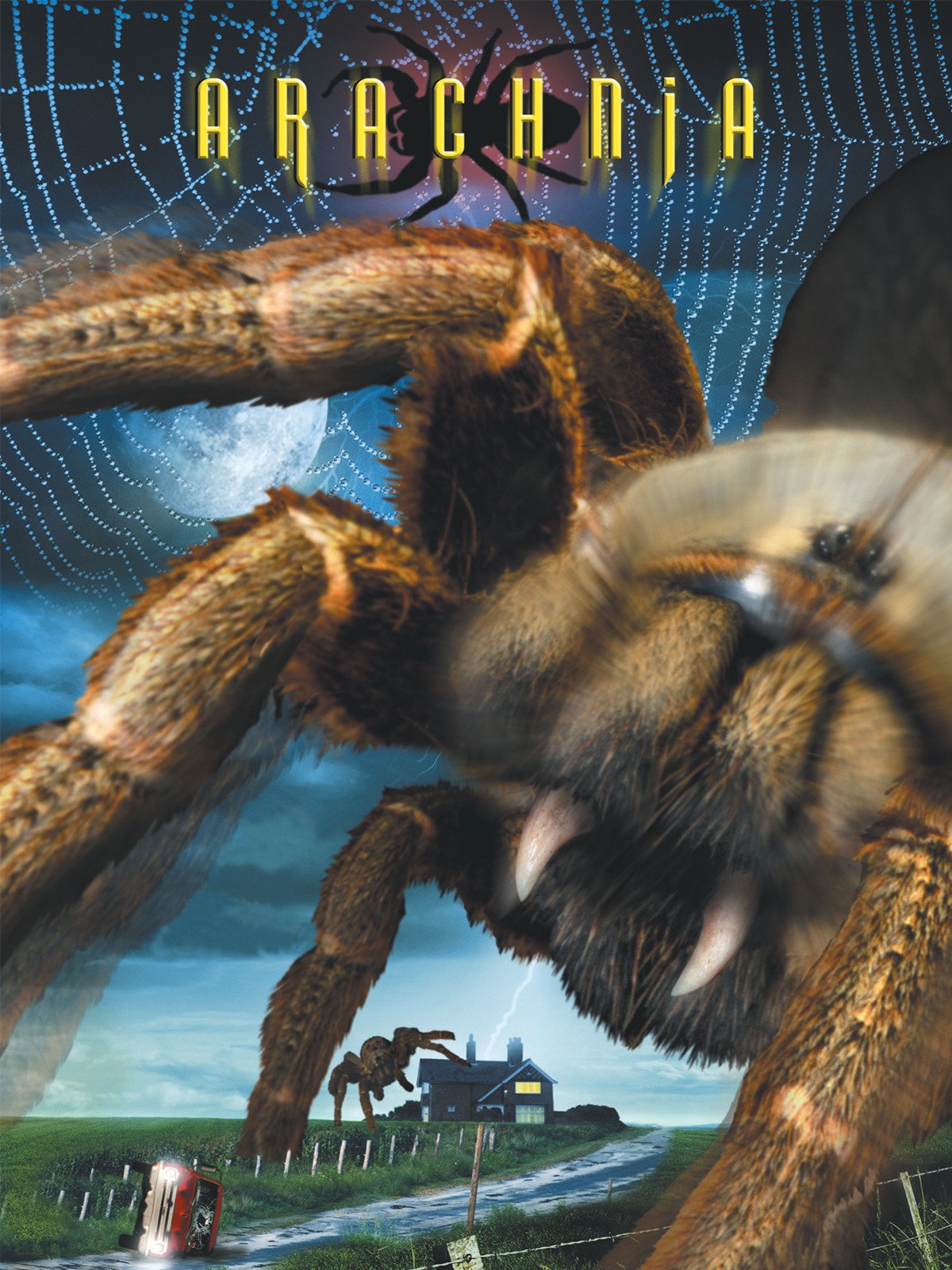
ARACHNIA - 2003
EUREKA!
Giant spiders violate the square-cube law in the sense that spiders as
big as horses wouldn’t be able to support their own weight
and would have a long list of internal problems like not being able
to absorb enough oxygen to survive. But when the snooty professor
is first told about (but hasn't yet seen)
the big spiders, he snootily points out exactly those facts! Later,
when we learn that the giant spiders are some unknown underground
species, all that's left for me or the snooty professor to
say is that it’s really unlikely but not impossible. |
|
THE MATRIX: REVOLUTIONS - 2003
There is a very brief scene where a ship piloted by the good guys gets
above ground and then, just for a moment, above the perpetual cloud
cover. Trinity sees the sun for real, probably for the first time
in her life. The sunny, beautiful world above the clouds is a huge
contrast to the grim horror below. But it's also more proof
that the whole "using people as batteries" idea (that's
what we are told the machines are using people for: electricity)
is stupid.
Totally aside from the simple fact that burning the food
you're feeding these people would provide more power than you'd
ever get from their body heat (humans are poor heat engines), just a few miles up you’ve got as
much solar energy as you want. The tech these machines have is plenty
for solar cell covered blimps or solar power satellites. I don't
know what they're using people for, but it ain't electricity. |
|
THE LEAGUE OF EXTRAORDINARY GENTLEMEN - 2003
There is a scene where we discover that Nemo's great submarine is solar
powered. Yeah, you heard me. Now that's not quite as stupid as it
seems because they mention this when the sub is on the surface,
charging its batteries with solar energy. But why would Hollywood
writers choose solar power when (nuclear) there is a much more (nuclear) obvious choice (nuclear) that the U.S. Navy has been (nuclear) using for many decades (nuclear)?
Who can say?
My guess is that solar energy, while perhaps not the most obvious choice as a submarine power source, was the most politically correct choice.
And by the way: in the original Jules Verne story Nemo's sub was
powered by extracting electrolytes from the water. That wouldn't
work but it still makes more sense than a solar powered submarine. |
|
PAYCHECK - 2003
The idea of any kind of "memory marker" artificially set in the
brain is something I'm pretty sure wouldn't work, given that memories are stored holographically
rather than linearly but maybe they learned a way around that. I
have to be careful because I don't want to ruin the surprise of
what Michael was working on. All I'll say is that although current
thinking on the topic would not allow the idea in question to work,
the whole subject is sufficiently in flux that I'm fine with a future
discovery making it workable. |
|
THE HULK - 2003
There are a lot of violations of basic physics here (like
if a multi-ton creature can leap miles into the air then by virtue
of equal-and-opposite-reaction he should kick a huge crater into
the ground with each leap), but the most blatant is the transformation
itself. If an average-sized man triples in height then according
to the square-cube law his weight will be three cubed or 27 times
greater. That means he goes from 200 pounds to 5400 pounds (more
than 2 and a half tons!). Where does that mass come from?
Not from "accelerated cell growth" because cells don't
just appear from nowhere. To gain 5200 pounds you'd have to
eat more than 5200 pounds of food and let your body process that
raw material INTO more cells. That's not what happens
here. The mass just magically appears (and then disappears when he changes back), a clear violation
of Conservation of Mass and Energy. Only magic can do that so this
is fantasy, not sci-fi. |
|
KING OF THE ANTS - 2003
There is a standard plot device in thrillers involving turning on the gas on a stove and either leaving a candle burning or waiting for someone to light a match and thereby blow up a house in a huge fireball. Very dramatic and it would sort of work. It's just that it would take hours for the house to fill with gas this way, not the mere minutes that's usually shown. |
|
TIME OF THE WOLF - 2003
I say frustrating because, since the movie never explains what happened,
there's no science for me to analyze. If I had to guess I'd say
some kind of terrorist-released plague was the culprit but the fact
is it could be a lot of different things. Civilization is surprisingly
fragile. |
|
2004
DAWN OF THE DEAD - 2004
One of the very cool things about the original three movies is that, in spite of a lot of scientific hand waving, they never figure out exactly why this is happening. A virus? A vengeful God? Alien Space Bats? It just happens and people have to deal with it.
The remake takes the same approach but it does give a slight nod in the "virus"
direction. I wasn't happy about that because there's no freakin'; way a virus could reanimate a dead body. Think about
it. A typical zombie is wandering around for months or years, never eating or drinking. No respiration, no heartbeat, and yet they can move. They don't heal but they also don't decay (if they did they'd be bloated, liquefying messes in days).
Something is animating them, maintaining their body in its present state, and providing enough biochemical energy for them to move around. I have no idea what could do that but it sure as hell isn't a virus.
UPDATE:
Writer James Gunn (DAWN OF THE DEAD [2004], SLITHER) responds:
"I don't see the problem in having zombies created with a bite. The bite never implies a virus. Vampires always make new vampires with a bite, so what's the difference?"
Kelly Parks answers, "Oh, yeah. That's right."
Feo Amante says, "Well so much for THIS freaking Science Moment!" |
THE
BUTTERFLY EFFECT - 2004
Is there really such a thing as a "Butterfly Effect"?
Yep, and this movie adheres pretty well to the scientific analogy. But the Butterfly Effect, a term coined by Jacques Hadamard in 1890, is just that: an analogy used to desribe how very small things can have enormous outcomes over periods of time. It's not now, nor was it ever a theory or even a hypothesis. The Butterfly Effect is also known as the Ripple Effect and it was never meant to suggest that a butterfly flapping its wings in one part of the world, could possibly create a storm elsewhere in the world.
In 1961, the "Father of Choas Theory", Edward Lorenz, after running a predictive weather computer model, discovered that his predictions were all wrong. How could that be? It was mathematically sound! After a re-analysis of his data, he discovered that just one of his entry decimal numbers, .506, was largely accurate, but minutely innaccurate. The proper number to get a slightly more accurate prediction should have been, .506127. The difference of a mere .000127 is so seemingly insignificant as to have originally gone unnoticed the first time. But over a course of time, and with the great and dynamic force of planetary weather, that small number, multiplying itself billions of times over, became huge. Thus the allegorical idea of a Butterfly or Ripple Effect: The circumference of the ripple is much larger than the initial pebble. The air moving from out of a butterfly's wings is much smaller than a hurricane.
Continued at !!!THE SCIENCE MOMENT!!!/The Butterfly Effect. |
TREMORS 4 - 2004
Hiram and Juan find the imprints of what they assume were buried eggs
near a creek. From this they jump to the conclusion that these creatures
must have been long buried and that the creek uncovered them and
caused them to hatch. The problem is that in TREMORS
2 we were told that the graboids are “Precambrian life
forms”, which means the eggs have been sitting there for half
a billion years. And still fresh? I’ll concede that it’s
not completely impossible but damn! |
|
STARSHIP TROOPERS 2 - 2004
This science moment involves a personal experience connected to this movie. I
was at the 2002 San Diego Comic Con and, while wandering around
one day, I came across a panel discussion about STARSHIP TROOPERS
2. Actress Brenda Strong, director Phil Tippett and writer Ed Neumeier
(and one of the producers, I think) were all there promoting the movie and taking questions from the
audience. So I took the opportunity to ask (as diplomatically as I could manage) why the first movie did
such a terrible job getting the science right, especially considering
that it was based on a Robert Heinlein novel and Heinlein was one
of the first "hard core" science fiction writers who always
made a serious effort to get the scientific details correct.
The reaction? Confusion. They looked at each other and back at me and clearly
didn't understand what I was talking about. They thought the science
was fine. Which explains a lot about these movies and about Hollywood in general. |
|
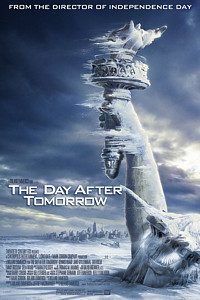
THE
DAY AFTER TOMORROW - 2004
We'll start with the two important questions you must answer when
you talk about global warming:
1. Is the Earth getting warmer?
2. If so, why is it getting warmer?
The problem is most people assume that if the answer is yes to the first question then the only possible answer to the second question is "we are causing the warming by pumping carbon dioxide into the atmosphere."
This is what is technically known as "jumping to conclusions."
You might be surprised to learn that there are many scientists who don't believe
global warming is happening at all. I'm not in that category - I
think the climate is getting warmer - but there is legitimate debate
on the topic.
Let me stress that point: there is legitimate scientific
debate as to whether or not global warming is happening at all.
For a good overview read "The Satanic Gases" by Patrick
J. Michaels and Robert C. Balling.
But for the sake of argument let's answer "yes" to our first question
and assume that the Earth is getting warmer. Are we causing this warming, as the movie implies? (And by "implies" I mean "beats you over the head with"). Before I answer that, let's consider a few things:
Real paleoclimatologists will tell you that the Earth's climate has been very different from
what it is now, sometimes warmer and sometimes colder, long before
humanity came along. There is evidence that the current warming
is a similar natural event caused by variations in solar activity
and that it would be happening whether we were here or not.
The glacier and ice cap melting many have pointed to as evidence of global warming
may have been caused by soot, not carbon dioxide. A fine layer of
soot darkens the ice just enough that it absorbs more sunlight than
it otherwise would and melts.
Speaking of soot, some researchers believe that small particles from pollution
(soot, aerosols, etc.) have a much greater cooling effect on the climate than previous models have
accounted for. If they're right then humanity has cooled the Earth, not warmed it.
Ever heard of Global Dimming? The amount of sunlight reaching the Earth's surface
has been decreasing for a while now. It was first discovered about
20 years ago but only recently has enough proof been accumulated
for scientists to take it seriously. This is probably also being
caused by soot (they think) and definitely has a cooling effect.
It's been known for a long time that developed land (agricultural and cities) absorbs more heat and make their surroundings warmer than natural landscapes. But a recent study has shown that this is effect is much larger than people thought, making it a significant contributor to warming.
A recent NASA study has shown that the contrails of high-flying jets over the
northern hemisphere causes increased formation of cirrus clouds.
These clouds trap heat like the glass in a greenhouse roof and this
effect alone may explain all the warming seen in the U.S. since the 1970's.
So what does all this contradictory and confusing stuff actually mean? It means
that the only honest answer anyone can give to the question, "Why
is the Earth getting warmer?" is "We don't know yet."
This shouldn't be surprising. The climate of a planet is a deeply
complex system, dependent on many, many variables, some of which
we haven't even discovered yet. Also note that several things we're
doing that may be affecting the climate have nothing to do with
carbon dioxide.
There have been a lot of climatologists interviewed in the media saying that although
the climate shift described in the movie (warming leads to polar melt leads to more fresh water in the ocean leads to shut down of the gulf stream leads to ice age) does have
some scientific merit, but that such a string of events would take
decades at least. A few days are out of the question. I actually
don't have a problem with the whole thing taking place in a few
days. It's probably impossible but I can enjoy a "what if"
scenario for disaster-movie purposes so that's fine.
However, the "message" of the movie, that global warming is being caused
by our carbon dioxide emissions and that the Kyoto Protocols (which
really would cost hundreds of billions of dollars) should
be instituted immediately is just plain wrong. That would be like
a doctor trying to diagnose a patient with a fever saying, "Maybe
I should take out his spleen, just to see what happens." Far
too drastic an action considering you don't know if it would help. |
|
SPIDER-MAN 2 - 2004
There were a variety of mistakes and poorly thought out details. Here are
the most obvious, in no particular order.
1. What is the power source for Doc Ock's tentacles? Just because he can control
them with his thoughts doesn't explain where their energy comes from.
2. Tritium is not especially rare. And it's an isotope of hydrogen and thus a
gas, not a metal.
3. Doc Ock's tentacles are very strong. But Doc Ock himself is just an ordinary
human being, not a superhuman. That means a single Spiderman punch
should have been then end of him. Actually, given how strong Spiderman is, it should have torn his head off. |
|
I, ROBOT - 2004
My only complaint is that the movie doesn't really make clear what a different
world it would be if intelligent robots were everywhere. There is
brief mention of people losing their jobs to robots, which would
certainly happen. But think about the effect on the economy if the
cost of labor was effectively zero.
Every product imaginable would
become dirt cheap, effectively making us all millionaires. And the
fast pace of scientific discovery we have now would seem glacial
compared to an era when smart machines are designing even smarter
machines. Some people call this rapidly approaching moment "The Singularity",
because once it happens knowledge expands so fast that it's impossible
for us to imagine what it would be like. |
|
DISTRICT B13 - 2004
Today the subject is social science and although I am far from a qualified social scientist, I’m going to make a prediction. There will be more and more movies made about crime and social breakdown in France in the years ahead. And the tone of the movies will change from sympathetic to the rioters (like this one) to decidedly unsympathetic as things get worse. And that’s all I’m going to say about that. |
|
ALIEN VS PREDATOR - 2004
The science in question is geography. The "island near Antarctica"
is called Bovetoya. This is a real island and is listed in the Guinness Book of World Records as the most isolated island (bare volcanic rock covered with glaciers and rarely visited by anyone) on Earth. But it's only "near" Antarctica if you think 1000 miles away is "near". The tip of South America is closer to Antarctica than Bovetoya. |
|
MEGALODON - 2004
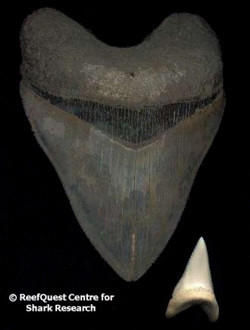
The Megalodon (which means "big tooth") is related to the Great White shark but it was quite a bit bigger: anywhere from 60 to 80 feet long.
The movie implies that the giant underground cave containing the shark had been sealed
for 65 million years (the end of the Cretaceous). This was unnecessary because Megalodons went extinct much more recently, probably within that last couple of million years (there are stories about Megalodon teeth that have been found and that may be only 10,000 years old!)
And speaking of the underground cave: this idea has shown up before (DEEPSTAR SIX, for example) but isn't very workable. There is life in the deep ocean but that ecology depends on the steady rain of organic material from near the surface. A cave would be
cut off from this mana from heaven and it's hard to imagine enough
life going on to support a population of very large predators. |
|
ANACONDAS: THE HUNT FOR THE BLOOD ORCHID - 2004
EUREKA!
The one thing I liked about this movie (the one and ONLY thing) was how they explained the big snakes.
The biggest anaconda ever measured was 28 feet long and the smallest
of these monsters is easily twice that. But it is true, as the movie
points out, that reptiles grow their whole lives so the older they
get, the bigger they get. Which means if the local environment included
an immortality-granting blood orchid as part of the food chain then
some of the wildlife might live long enough to get really big. |
|
RESIDENT EVIL: APOCALYPSE - 2004
Part of the storyline is that Umbrella, the cartoonishly evil corporation,
plans to sanitize the infection in Raccoon City with a nuke. Then
to avoid awkward questions about where they got a nuke and why they're
blowing up cities, they plan on saying that the explosion was actually
caused by a meltdown at the local nuclear power plant. Which is,
of course, impossible.
A fission chain reaction requires some very special materials. Specifically
you need nearly pure uranium 235 (or plutonium
239, but that's never used in reactors). Naturally occurring
uranium is mostly U-238 which is quite useless for fission. Only
one atom in 7000 is the 235 isotope and the first thing you have
to do to build a nuke is separate the 235 from the 238 until you
have better than 95% U-235 ("weapons
grade"). Only then can a chain reaction of atoms splitting
and releasing neutrons, which split more atoms, be achieved.
Nuclear power plants use uranium that has been enriched to about 3% U-235.
It's very radioactive and if you surround it with neutron reflecting
materials it can get very hot. But it simply can't sustain a chain
reaction and it can't produce a nuclear explosion.
One other point: You'd think that when Umbrella tried to say the nuclear
power plant caused the nuclear explosion, someone would have said,
"Really? So an explosion at the power plant on the edge of
town created this big crater in the center of town? Are you sure
you want to go with that story?" |
|
THE FORGOTTEN - 2004
EUREKA!
A very short science moment because I can't say much without spoiling
a surprise or two. So all I will say is to mention one of Clarke's
Laws: "A sufficiently advanced technology will be indistinguishable
from magic." |
|
THE INCREDIBLES - 2004
EUREKA!
There are usually two schools of thought regarding superheroes and science.
The first is to analyze their abilities based on known physics and
point out all the various impossibilities, most of which boil down
to violations of the Law of Conservation of energy. The other school
of thought states that superheroes are fantasy and therefore it's
a mistake to use a scientific point of view just as it would be
a mistake to analyze the science in Lord of the Rings.
There is a third path. I found it in the Robert Heinlein story "Waldo",
where the inventor / scientist Waldo Jones is faced with proof of
the existence of Magic. Rather than having his worldview and his
mind crumble (as happens to another character in the story) Waldo simply guesses that an undiscovered energy
source (probably extra-dimensional) is being tapped into and leaves it at that. We don't know everything
yet, after all. This neatly and empirically explains all superheroes-who-violate-physics-especially-Conservation-of-Energy.
So there. |
BLADE: TRINITY - 2004
One of the defining characteristics of vampires is that their strength
and reflexes are far superior to humans. The combination of their
speed and great strength is what makes them such deadly predators.
Blade has these abilities as well, which is why he can fight vampires
hand-to-hand. But Abigail and Hannibal are just ordinary human beings
(well, Hannibal had an odd past but he's an ordinary human now). So I don't care how strong their Kung
Fu is, they should NOT be able to get in fist fights with
vampires. And yet they do, time and again, with no explanation as
to how this is possible.
As far as regular science is concerned, the movie stretched my suspension of disbelief
but didn't break it. I can imagine a virus that alters humans into
another species with unusual abilities. But a virus that could do
all these things could never evolve on its own. It would have to
be artificial. |
|
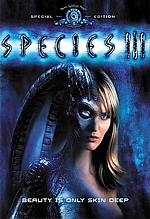
SPECIES III - 2004
Dean says that his reactor uses hydrogen and deuterium and fusion occurs "when
these two elements combine". In fact they are the same element.
Deuterium (and tritium) are just isotopes of hydrogen. Plain hydrogen (also called protium)
is a single proton orbited by a single electron. Deuterium is the
same arrangement plus a neutron and tritium is the same plus two
neutrons. But they're all hydrogen and are chemically identical. |
|
FRANKENFISH - 2004
EUREKA!
The genetically engineered creature in question actually wasn't that bad. It's big but not violates-the-square-cube-law big and its behavior is way too smart and basically monster overacting but its certainly on a par with the rest of the movie. The fact is that creating monsters like this is either doable today or will be by next Tuesday, depending on how ethical the molecular biologist you ask the question is. |
|
DECOYS - 2004
EUREKA!
We find out that these girls aren't just randomly killing guys for fun -
they're attempting to mate with them. The fact that the implanted
embryos end up immediately killing their male hosts is a disappointment
to the girls, but they figure with enough experimentation they'll
get it right.
Normally, I'd dismiss that as stupid since there isn't a single animal on Earth capable of crossbreeding with humans (and
all life on Earth is based on DNA), so the idea of successfully crossbreeding with an alien life form with a completely different evolutionary history and a vastly different biochemistry is astronomically unlikely. Unless, of course, you're from an advanced alien civilization with a good knowledge of exobiology and have done this sort of thing before. Then maybe it would just take some genetic engineering and
some unwilling test subjects. |
|
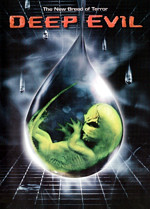
DEEP EVIL - 2004
The alien "creature" doesn't quite violate any laws of physics or
anything (although the apparent difference in mass between its various forms come close) but I willpoint out that its ability to interface with Earthlings means it could only be artificial. Life may or may not exist throughout the
Universe but if it does then each time it appears it will have its own unique biochemistry and its own version of something like DNA. So the idea of life from one planet being able to eat (or mate with) life from another planet is truly unlikely. |
|
Continue
to
2005 to 2006

Back to
MOVIES |
|
























 Interviewed by the prestigious The Scientist Magazine.